Sd value measures how strongly a material resists water vapour passing through it. It is expressed in metres, as the thickness of still air with equivalent resistance. A lower Sd lets vapour pass through more easily; a higher Sd provides greater resistance. Neither is automatically better: the right value depends on the complete wall or roof.
What does a low or high Sd value mean?
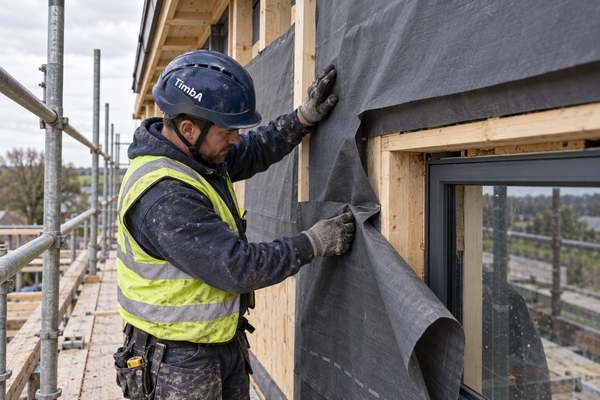
A vapour-open membrane has a low Sd value and can support drying where the surrounding construction allows it. A vapour-control layer or barrier limits diffusion. A variable membrane changes its resistance with humidity. These products have different jobs; choose the role first, then check the declared value and application.
How is Sd calculated?
Sd = μ × d, where μ is the material’s vapour diffusion resistance factor and d is its thickness in metres. For an illustrative calculation, μ = 50 and d = 0.02 m give Sd = 1 m. For a membrane, use the manufacturer’s declared Sd rather than estimating it from thickness alone.
Sd value is different from airtightness
Sd describes vapour diffusion through a material. Airtightness controls air leakage through gaps, joints and penetrations. A suitable Sd value does not compensate for poorly sealed laps or junctions. Nor does it establish waterproofing or fire performance; check those properties separately.
Real membrane examples
These supplier-declared values illustrate the difference between membrane types. They are not a recommendation to combine the three products in one build-up.
| Product | Declared Sd | Role to check against your design |
|---|---|---|
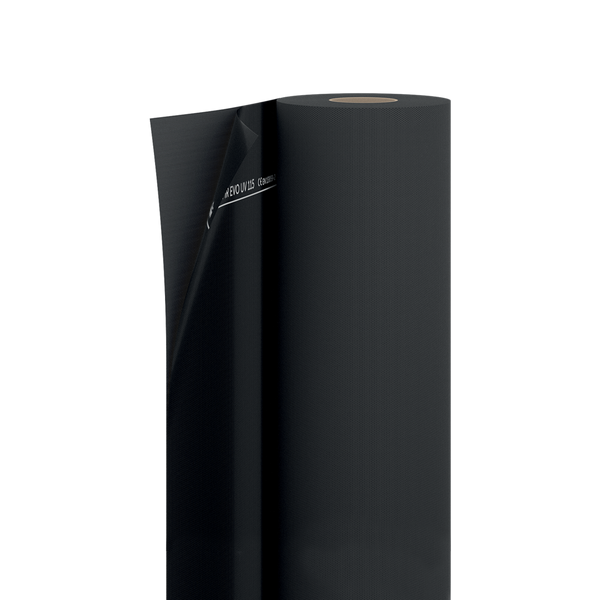
| Traspir EVO UV 115 | 0.08 m | Vapour-open, UV-resistant membrane for external walls. Check the supplier’s cladding-joint and exposure limits. |
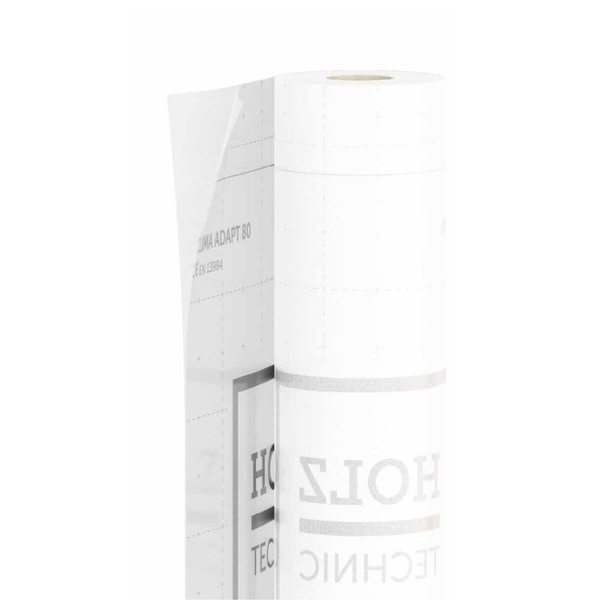
| Clima Adapt 80 | 0.15–5 m, variable with humidity | Internal membrane with variable vapour diffusion resistance. Check suitability for the complete construction. |
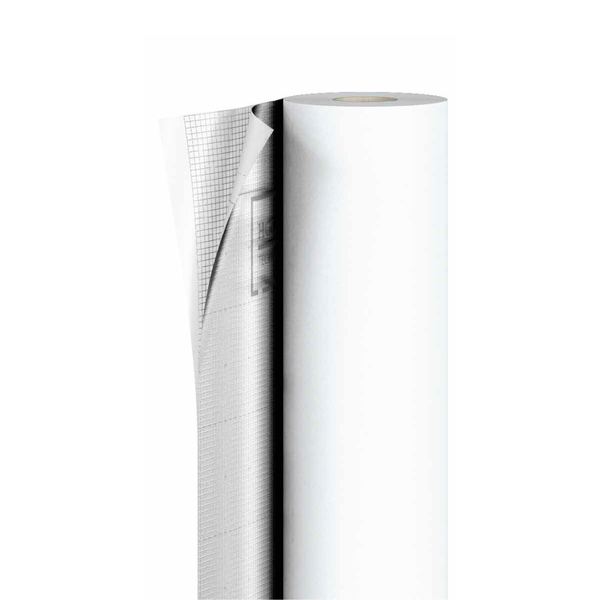
| Stop House Alu Net 100 | 150 m | Reflective vapour barrier with high diffusion resistance, where specified by the design. |
Check the latest technical sheet linked from each product page before ordering. Sd alone does not determine whether a membrane is suitable.
Where do the layers go in a timber-frame wall?
For a conventional ventilated-cladding timber-frame wall, an illustrative outside-to-inside sequence is:
- External cladding
- Ventilated and drained cavity
- Breather membrane
- External sheathing
- Timber frame with insulation between the studs
- Air and vapour control layer, where required by the design
- Internal service void
- Internal lining
The breather membrane is outside the sheathing; the service void is on the room side of the air and vapour control layer. This illustration is not a construction specification. Continuous insulation, different cladding systems and other designs can change the arrangement.
How should I choose a membrane?
- Identify the layer’s purpose and position.
- Check the whole build-up, climate, indoor moisture conditions and drying paths.
- Read the declared Sd, exposure limits, fire performance and installation guidance.
- Choose compatible tapes and seals, and plan continuous airtightness.
- Have the designer confirm the moisture strategy and the appropriate condensation assessment.
“More resistant inside, more open outside” can describe many conventional designs, but it is not a universal rule. A wall or roof cannot be verified from two membrane values alone.
Common questions
Is a higher Sd value always better?
No. Higher resistance can limit vapour diffusion, but may also restrict drying. The complete construction determines the suitable choice.
Can a smart membrane solve every condensation problem?
No. Variable resistance can support drying in suitable constructions, but it does not replace sound design, installation or assessment.
Can I use the same membrane in a wall and roof?
Only where the manufacturer permits the application and the design supports it. Do not transfer this wall illustration to a roof detail.
Comparing membranes for your project?
Compare our membranes, then check each product’s declared Sd and intended application. Send us your proposed build-up or drawing for product-selection help. Where moisture modelling or technical sign-off is needed, the scope must be agreed with the appropriate specialist.
Sources and further reading
- Pro Clima: vapour diffusion, airtightness and drying capacity
- NHBC: illustrated timber-frame panel arrangements
- Rothoblaas technical data: Traspir EVO UV 115; Holz Technic catalogue, pages 192–193, for Stop House Alu Net 100 and Clima Adapt 80.